


Кто за главного? Свобода воли с точки зрения нейробиологии - Майкл Газзанига
Книгу Кто за главного? Свобода воли с точки зрения нейробиологии - Майкл Газзанига читаем онлайн бесплатно и без регистрации! Читать онлайн вы можете не только на компьютере, но и на андроид (Android), iPhone и iPad. Наслаждайтесь!
239 0 20:33, 17-05-2019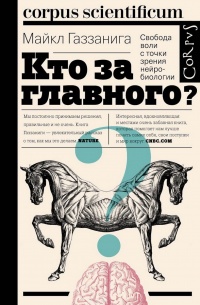
 ЧИТАТЬ КНИГУ ОФЛАЙН в приложении android
Книга Кто за главного? Свобода воли с точки зрения нейробиологии - Майкл Газзанига читать онлайн бесплатно без регистрации
8 Schachter S., Singer J. E. (1962) Cognitive, social, physiological determinants of emotional state. Psychology Review. 69: 379-399.
9 Miller M.B., Valsangkar-Smyth M. (2005) Probability matching in the right hemisphere. Brain and Cognition. 57 (2): 165-167.
10 Wolford G. et al. (2004) Split decisions. In: Gazzaniga M.S. (ed.) The cognitive neurosciences III (P. 1189-1199). Cambridge, MA: The MIT Press.
11 Corballis P. (2003) Visuospatialprocessing and the right-hemisphere interpreter. Brain and Cognition. 53 (2): 171-176.
12 Corballis P. M. et al. (1999) Illusory contour perception and a modal boundary completion: evidence of a dissociation following callosotomy. Journal of Cognitive Neuroscience. 11 (4): 459-466.
13 Corballis P. M. etal. (2002) Hemispheric asymmetries for simple visual judgments in the split brain. Neuropsychologia. 40 (4): 401-410.
14 Corballis M.C., Sergent J. (1988) Imagery in a commis-surotomized patient. Neuropsychologia. 26 (1): 13-26.
15 См.: Funnell M. G. et al. (2003) Temporal discrimination in the split brain. Brain and Cognition. 53 (2): 218-222; а также Handy T. C. et al. (2003) Cortical and subcortical contributions to the representation of temporal information. Neuropsychologia. 41 (11): 1461-1473.
16 Hikosaka O. etal. (1993) Focal visual attention produces illusory temporal order and motion sensation. Vision Research. 33 (9): 1219-1240.
17 Tse P. et al. (1998) The role of parsing in high-level motion processing. In: Watanabe T. (ed.) High-level motion processing: computational, neurobiological, and psychophysical perspectives (P 249-266). Cambridge, MA: The MIT Press.
18 Corballis P. M. et al. (2002) An investigation of the line motion effect in a callosotomy patient. Brain and Cognition. 48 (2-3): 327-332.
19 Ramachandran V. S. (1995) Anosognosia in parietal lobe syndrome. Conciousness and Cognition. 4 (1): 22-51.
20 Hirstein W., Ramachandran V. S. (1997) Capgras syndrome: a novel probe for understanding the neural representation of the identity and familiarity of persons. Proceedings of the Royal Society of London. B: Biological Sciences. 264 (1380): 437-444.
21 Doran J. M. (1990) The Capgras syndrome: neurological/neuropsychological perspectives. Neuropsychology. 4 (1): 29-42.
22 Roser M. E. et al. (2005) Dissociating processes supporting causal perception and causal inference in the brain. Neuropsychology. 19 (5): 591-602.
23 Gazzaniga M. S. (1983) Right hemisphere language following brain bisection: a 20-year perspective. American Psychologist. 38 (5): 525-537.
24 Gazzaniga M. S., LeDoux J. E. (1978) The integrated mind. NY: Plenum Press.
25 Roser M., Gazzaniga M. S. (2004) Automatic brains — interpretive minds. Current Directions in Psychological Science. 13 (2): 56-59.
Глава 4. Отказ от понятия свободы воли
1 Частная беседа.
2 Fried I. et al. (1991) Functional organization of human supplementary motor cortex studied by electrical stimulation. Journal of Neuroscience. 11 (11): 3656-3666.
3 Thaler D. et al. (1995) The functions of the medial premotor cortex. /. Simple learned movements. Experimental Brain Research. 102 (3): 445-460.
4 Lau H. et al. (2006) Dissociating response selection and conflict in the medial frontal surface. Neuroimage. 29 (2): 446-451.
5 Lau H. CL et al. (2007) Manipulating the experienced onset of intention after action execution. Journal of Cognitive Neuroscience. 19 (1): 1-10.
6 Vohs K. D., Schooler J. W. (2008) The value in believing in free will. Encouraging a belief in determinism increases cheating. Psychological Science. 19 (1): 49-54.
7 См.: Harmon-Jones Е., Mills J. (1999) Cognitive dissonance: progress on a pivotal theory in social psychology. Washington, DC: American Psychological Association; а также Mueller C.M., Dweek C.S. (1998) Intelligence praise can undermine motivation and performance. Journal of Personality and Social Psychology. 75: 33-52.
8 См.: Baumeister R. F. et al. (1998) Ego depletion: is the active self a limited resource? Journal of Personality and Social Psychology. 4: 1252-1265; Gailliot M. T. et al. (2007) Self-control relies on glucose as a limited energy source: willpower is more than a metaphor. Journal of Personality and Social Psychology. 92: 325-336; а также Vohs K. D. et al. (2008) Making choices impairs subsequent self-control: a limited-resource account of decision making, self-regulation, and active initiative. Journal of Personality and Social Psychology. 94: 883-898.
9 Baumeister R. F. et al. (2009) Prosocial benefits of feeling free: disbelief in free will increases aggression and reduces helpfulness. Personality and Social Psychology Bulletin. 35 (2): 260-268.
10 Dawkins R. (2006) Let's all stop beating Basil's car. Cm.: https://edge.org/q2006/q06_9.html
11 O’Connor J.J., Robertson E. F. (2008) Edward Norton Lorenz. Cm.: http://www-history.mcs.st-andrews.ac.uk/Biographies/Lorenz_Edward.html
12 Feynman R. (1998) The meaning of it all. NY: Perseus Books Group.
13 Bohr M. (1937) Causality and complementarity. Philosophy of Science. 4 (3): 289-298.
14 Isaacson W. (2007) Einstein: his life and universe. NY: Simon & Schuster.[45]
15 Pattee H. H. (2001) Causation, control, and the evolution of complexity. In: Andersen R B. et al. (eds.) Downward causation: minds, bodies and matter (P 63-77). Copenhagen: Aarhus University Press.
16 Goldstein J. (1999) Emergence as a construct: history and issues. Emergence: Complexity and Organization. 1 (1): 49-72.
17 Laughlin R. B. (2006) A different universe: reinventing physics from the bottom down. NY: Basic Books.
18 Feynman R. P. et al. (1995) Six easy pieces: essentials of physics explained by its most brilliant teacher (P. 135). NY: Basic Books.[46]
19 Bunge M. (2010) Matter and mind: a philosophical inquiry (P. 77). Dordrecht: Springer Verlag.
20 Libet B. et al. (1979) Subjective referral of the timing for a conscious sensory experience: a functional role for the somatosensory specific projection system in man. Brain. 102 (1): 193-224.



Прочитали книгу? Предлагаем вам поделится своим впечатлением! Ваш отзыв будет полезен читателям, которые еще только собираются познакомиться с произведением.
Уважаемые читатели, слушатели и просто посетители нашей библиотеки! Просим Вас придерживаться определенных правил при комментировании литературных произведений.
Просьба отказаться от дискриминационных высказываний. Мы защищаем право наших читателей свободно выражать свою точку зрения. Вместе с тем мы не терпим агрессии. На сайте запрещено оставлять комментарий, который содержит унизительные высказывания или призывы к насилию по отношению к отдельным лицам или группам людей на основании их расы, этнического происхождения, вероисповедания, недееспособности, пола, возраста, статуса ветерана, касты или сексуальной ориентации. Просьба отказаться от оскорблений, угроз и запугиваний. Просьба отказаться от нецензурной лексики. Просьба вести себя максимально корректно как по отношению к авторам, так и по отношению к другим читателям и их комментариям.
Надеемся на Ваше понимание и благоразумие. С уважением, администратор сайта
Оставить комментарий

 Mkot1312 июль 21:17


