


Думай как математик. Как решать любые задачи быстрее и эффективнее - Барбара Оакли
Книгу Думай как математик. Как решать любые задачи быстрее и эффективнее - Барбара Оакли читаем онлайн бесплатно и без регистрации! Читать онлайн вы можете не только на компьютере, но и на андроид (Android), iPhone и iPad. Наслаждайтесь!
296 0 19:41, 24-05-2019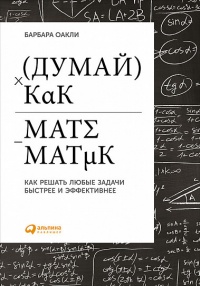
 ЧИТАТЬ КНИГУ ОФЛАЙН в приложении android
Книга Думай как математик. Как решать любые задачи быстрее и эффективнее - Барбара Оакли читать онлайн бесплатно без регистрации
Levin, J. R., et al. “Mnemonic vocabulary instruction: Additional effectiveness evidence.” Contemporary Educational Psychology 17, 2 (1992): 156–174.
Longcamp, M., et al. “Learning through hand- or typewriting influences visual recognition of new graphic shapes: Behavioral and functional imaging evidence.” Journal of Cognitive Neuroscience 20, 5 (2008): 802–815.
Lutz, A., et al. “Attention regulation and monitoring in meditation.” Trends in Cognitive Sciences 12, 4 (2008): 163.
Lützen, J. Mechanistic Images in Geometric Form. New York: Oxford University Press, 2005.
Lyons, I. M., and S. L. Beilock. “When math hurts: Math anxiety predicts pain network activation in anticipation of doing math.” PLOS ONE 7, 10 (2012): e48 076.
Maguire, E. A., et al. “Routes to remembering: The brains behind superior memory.” Nature Neuroscience 6, 1 (2003): 90–95.
Mangan, B. B. “Taking phenomenology seriously: The ‘fringe’ and its implications for cognitive research.” Consciousness and Cognition 2, 2 (1993): 89–108.
Mastascusa, E. J., et al. Effective Instruction for STEM Disciplines. San Francisco: Jossey-Bass, 2011.
McClain, D. L. “Harnessing the brain’s right hemisphere to capture many kings.” New York Times, January 24 (2011). http://www.nytimes.com/2011/01/25/science/25chess.html?_r=0
McCord, J. “A thirty-year follow-up of treatment effects.” American Psychologist 33, 3 (1978): 284.
McDaniel, M. A., and A. A. Callender. “Cognition, memory, and education.” In Cognitive Psychology of Memory, Vol. 2 of Learning and Memory, edited by H. L. Roediger, 819–843. Oxford, UK: Elsevier, 2008.
McGilchrist, I. The Master and His Emissary. New Haven, CT: Yale University Press, 2010.
Mihov, K. M., et al. “Hemispheric specialization and creative thinking: A meta-analytic review of lateralization of creativity.” Brain and Cognition 72, 3 (2010): 442–448.
Mitra, S., et al. “Acquisition of computing literacy on shared public computers: Children and the ‘hole in the wall.’” Australasian Journal of Educational Technology 21, 3 (2005): 407.
Morris, P. E., et al. “Strategies for learning proper names: Expanding retrieval practice, meaning and imagery.” Applied Cognitive Psychology 19, 6 (2005): 779–798.
Moussa, M. N., et al. “Consistency of network modules in resting-state fMRI connectome data.” PL0S ONE 7, 8 (2012): e49 428.
Mrazek, M., et al. “Mindfulness training improves working memory capacity and GRE performance while reducing mind wandering.” Psychological Science 24, 5 (2013): 776–781.
Nagamatsu, L. S., et al. “Physical activity improves verbal and spatial memory in adults with probable mild cognitive impairment: A 6-month randomized controlled trial.” Journal of Aging Research (2013): 861–893.
Nakano, T., et al. “Blink-related momentary activation of the default mode network while viewing videos.” Proceedings of the National Academy of Sciences 110, 2 (2012): 702–706.
National Survey of Student Engagement. Promoting Student Learning and Institutional Improvement: Lessons from NSSE at 13. Bloomington: Indiana University Center for Postsecondary Research, 2012.
Newport, C. How to Become a Straight-A Student. New York: Random House, 2006.
Newport, C. So Good They Can’t Ignore You. New York: Business Plus, 2012.
Niebauer, C. L., and K. Garvey. “Gödel, Escher, and degree of handedness: Differences in interhemispheric interaction predict differences in understanding self-reference.” Laterality: Asymmetries of Body, Brain and Cognition 9, 1 (2004): 19–34.
Nielsen, J. A., et al. “An evaluation of the left-brain vs. right-brain hypothesis with resting state functional connectivity magnetic resonance imaging.” PLOS ONE 8, 8 (2013).
Noesner, G. Stalling for Time. New York: Random House, 2010.
Noice, H., and T. Noice. “What studies of actors and acting can tell us about memory and cognitive functioning.” Current Directions in Psychological Science 15, 1 (2006): 14–18.
Nyhus, E., and T. Curran. “Functional role of gamma and theta oscillations in episodic memory.” Neuroscience and Biobehavioral Reviews 34, 7 (2010): 1023–1035.
Oakley, B. A. “Concepts and implications of altruism bias and pathological altruism.” Proceedings of the National Academy of Sciences 110, Supplement 2 (2013): 10 408–10 415.
Oakley, B., et al. “Turning student groups into effective teams.” Journal of Student Centered Learning 2, 1 (2003): 9–34.
Oaten, M., and K. Cheng. “Improved self-control: The benefits of a regular program of academic study.” Basic and Applied Social Psychology 28, 1 (2006): 1–16.
Oaten, M., and K. Cheng. “Improvements in self-control from financial monitoring.” Journal of Economic Psychology 28, 4 (2007): 487–501.
Oettingen, G., et al. “Turning fantasies about positive and negative futures into self-improvement goals.” Motivation and Emotion 29, 4 (2005): 236–266.
Oettingen, G., and J. Thorpe. “Fantasy realization and the bridging of time.” In Judgments over Time: The Interplay of Thoughts, Feelings, and Behaviors, edited by L. A. Sanna and E. C. Chang, 120–142. New York: Oxford University Press, 2006.
Oudiette, D., et al. “Evidence for the re-enactment of a recently learned behavior during sleepwalking.” PLOS ONE 6, 3 (2011): e18 056.
Pachman, M., et al. “Levels of knowledge and deliberate practice.” Journal of Experimental Psychology 19, 2 (2013): 108–119.
Partnoy, F. Wait. New York: Public Affairs, 2012.
Pashler, H., et al. “When does feedback facilitate learning of words?” Journal of Experimental Psychology: Learning, Memory, and Cognition 31, 1 (2005): 3–8.
Paul, A. M. “The machines are taking over.” New York Times, September 14 (2012). http://www.nytimes.com/2012/09/16/magazine/how-computerized-tutors-are-learning-to-teach-humans.html?pagewanted=all
Paul, A. M. “You’ll never learn! Students can’t resist multitasking, and it’s impairing their memory.” Slate, May 3 (2013). http://www.slate.com/articles/health_and_science/science/2013/05/multitasking_while_studying_divided_attention_and_technological_gadgets.3.html
Pennebaker, J. W., et al. “Daily online testing in large classes: Boosting college performance while reducing achievement gaps.” PLOS ONE 8, 11 (2013): e79 774.
Pert, C. B. Molecules of Emotion. New York: Scribner, 1997.
Pesenti, M., et al. “Mental calculation in a prodigy is sustained by right prefrontal and medial temporal areas.” Nature Neuroscience 4, 1 (2001): 103–108.


Прочитали книгу? Предлагаем вам поделится своим впечатлением! Ваш отзыв будет полезен читателям, которые еще только собираются познакомиться с произведением.
Уважаемые читатели, слушатели и просто посетители нашей библиотеки! Просим Вас придерживаться определенных правил при комментировании литературных произведений.
Просьба отказаться от дискриминационных высказываний. Мы защищаем право наших читателей свободно выражать свою точку зрения. Вместе с тем мы не терпим агрессии. На сайте запрещено оставлять комментарий, который содержит унизительные высказывания или призывы к насилию по отношению к отдельным лицам или группам людей на основании их расы, этнического происхождения, вероисповедания, недееспособности, пола, возраста, статуса ветерана, касты или сексуальной ориентации. Просьба отказаться от оскорблений, угроз и запугиваний. Просьба отказаться от нецензурной лексики. Просьба вести себя максимально корректно как по отношению к авторам, так и по отношению к другим читателям и их комментариям.
Надеемся на Ваше понимание и благоразумие. С уважением, администратор сайта
Оставить комментарий

 Mkot1312 июль 21:17


