


Думай как математик. Как решать любые задачи быстрее и эффективнее - Барбара Оакли
Книгу Думай как математик. Как решать любые задачи быстрее и эффективнее - Барбара Оакли читаем онлайн бесплатно и без регистрации! Читать онлайн вы можете не только на компьютере, но и на андроид (Android), iPhone и iPad. Наслаждайтесь!
297 0 19:41, 24-05-2019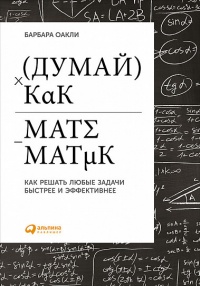
 ЧИТАТЬ КНИГУ ОФЛАЙН в приложении android
Книга Думай как математик. Как решать любые задачи быстрее и эффективнее - Барбара Оакли читать онлайн бесплатно без регистрации
Geary, D. C. The Origin of Mind. Washington, DC: American Psychological Association, 2005.
Geary, D. C. “Primal brain in the modern classroom.” Scientific American Mind 22, 4 (2011): 44–49.
Geary, D. C., et al. “Task Group Reports of the National Mathematics Advisory Panel; Chapter 4: Report of the Task Group on Learning Processes.” 2008. http://www2.ed.gov/about/bdscomm/list/mathpanel/report/learning-processes.pdf
Gentner, D., and M. Jeziorski. “The shift from metaphor to analogy in western science.” In Metaphor and Thought, edited by A. Ortony, 447–480. Cambridge, UK: Cambridge University Press, 1993.
Gerardi, K., et al. “Numerical ability predicts mortgage default.” Proceedings of the National Academy of Sciences 110, 28 (2013): 11267–11271.
Giedd, J. N. “Structural magnetic resonance imaging of the adolescent brain.” Annals of the New York Academy of Sciences 1021, 1 (2004): 77–85.
Gleick, J. Genius. New York: Pantheon Books, 1992.
Gobet, F. “Chunking models of expertise: Implications for education.” Applied Cognitive Psychology 19, 2 (2005): 183–204.
Gobet, F., et al. “Chunking mechanisms in human learning.” Trends in Cognitive Sciences 5, 6 (2001): 236–243.
Gobet, F., and H. A. Simon. “Five seconds or sixty? Presentation time in expert memory.” Cognitive Science 24, 4 (2000): 651–682.
Graham, P. “Good and bad procrastination.” 2005. http://paulgraham.com/procrastination.html
Granovetter, M. “The strength of weak ties: A network theory revisited.” Sociological Theory 1, 1 (1983): 201–233.
Granovetter, M. S. “The strength of weak ties.” American Journal of Sociology (1973): 1360–1380.
Gruber, H. E. “On the relation between aha experiences and the construction of ideas.” History of Science Cambridge 19, 1 (1981): 41–59.
Guida, A., et al. “How chunks, long-term working memory and templates offer a cognitive explanation for neuroimaging data on expertise acquisition: A twostage framework.” Brain and Cognition 79, 3 (2012): 221–244.
Gŭntŭrkŭn, O. “Hemispheric asymmetry in the visual system of birds.” In The Asymmetrical Brain, edited by K. Hugdahl and R. J. Davidson, 3–36. Cambridge, MA: MIT Press, 2003.
Hake, R. R. “Interactive-engagement versus traditional methods: A six-thousand-student survey of mechanics test data for introductory physics courses.” American Journal of Physics 66 (1998): 64–74.
Halloun, I. A., and D. Hestenes. “The initial knowledge state of college physics students.” American Journal of Physics 53, 11 (1985): 1043–1055.
Houdé, O. “Consciousness and unconsciousness of logical reasoning errors in the human brain.” Behavioral and Brain Sciences 25, 3 (2002): 341–341.
Houdé, O., and N. Tzourio-Mazoyer. “Neural foundations of logical and mathematical cognition.” Nature Reviews Neuroscience 4, 6 (2003): 507–513.
Immordino-Yang, M. H., et al. “Rest is not idleness: Implications of the brain’s default mode for human development and education.” Perspectives on Psychological Science 7, 4 (2012): 352–364.
James, W. Principles of Psychology. New York: Holt, 1890.
Ji, D., and M. A. Wilson. “Coordinated memory replay in the visual cortex and hippocampus during sleep.” Nature Neuroscience 10, 1 (2006): 100–107.
Jin, X. “Basal ganglia subcircuits distinctively encode the parsing and concatenation of action sequences.” Nature Neuroscience 17 (2014): 423–430.
Johansson, F. The Click Moment. New York: Penguin, 2012.
Kalbfleisch, M. L. “Functional neural anatomy of talent.” The Anatomical Record Part B: The New Anatomist 277, 1 (2004): 21–36.
Kamkwamba, W., and B. Mealer. The Boy Who Harnessed the Wind. New York: Morrow, 2009.
Kapur, M., and K. Bielczyc. “Designing for productive failure.” Journal of the Learning Sciences 21, 1 (2012): 45–83.
Karpicke, J. D. “Retrieval-based learning: Active retrieval promotes meaningful learning.” Current Directions in Psychological Science 21, 3 (2012): 157–163.
Karpicke, J. D., and J. R. Blunt. “Response to comment on ‘Retrieval practice produces more learning than elaborative studying with concept mapping.’” Science 334, 6055 (2011a): 453–453.
Karpicke, J. D., and J. R. Blunt. “Retrieval practice produces more learning than elaborative studying with concept mapping.” Science 331, 6018 (2011b): 772–775.
Karpicke, J. D., et al. “Metacognitive strategies in student learning: Do students practice retrieval when they study on their own?” Memory 17, 4 (2009): 471–479.
Karpicke, J. D., and P. J. Grimaldi. “Retrieval-based learning: A perspective for enhancing meaningful learning.” Educational Psychology Review 24, 3 (2012): 401–418.
Karpicke, J. D., and H. L. Roediger. “The critical importance of retrieval for learning.” Science 319, 5865 (2008): 966–968.
Kaufman, A. B., et al. “The neurobiological foundation of creative cognition.” Cambridge Handbook of Creativity (2010): 216–232.
Kell, H. J., et al. “Creativity and technical innovation: Spatial ability’s unique role.” Psychological Science 24, 9 (2013): 1831–1836.
Keller, E. F. A Feeling for the Organism, 10th Aniversary Edition: The Life and Work of Barbara McClintock. New York: Times Books, 1984.
Keresztes, A., et al. “Testing promotes long-term learning via stabilizing activation patterns in a large network of brain areas.” Cerebral Cortex (advance access, published June 24, 2013).
Kinsbourne, M., and M. Hiscock. “Asymmetries of dual-task performance.” In Cerebral Hemisphere Asymmetry, edited by J. B. Hellige, 255–334. New York: Praeger, 1983.
Klein, G. Sources of Power. Cambridge, MA: MIT Press, 1999.
Klein, H., and G. Klein. “Perceptual/cognitive analysis of proficient cardio-pulmonary resuscitation (CPR) performance.” Midwestern Psychological Association Conference, Detroit, MI, 1981.
Klingberg, T. The Overflowing Brain. New York: Oxford University Press, 2008.
Kornell, N., et al. “Unsuccessful retrieval attempts enhance subsequent learning.” Journal of Experimental Psychology: Learning, Memory, and Cognition 35, 4 (2009): 989.
Kounios, J., and M. Beeman. “The Aha! moment: The cognitive neuroscience of insight.” Current Directions in Psychological Science 18, 4 (2009): 210–216.
Kruger, J., and D. Dunning. “Unskilled and unaware of it: How difficulties in one’s own incompetence lead to inflated self-assessments.” Journal of Personality and Social Psychology 77, 6 (1999): 1121–1134.
Leonard, G. Mastery. New York: Plume, 1991.
Leutner, D., et al. “Cognitive load and science text comprehension: Effects of drawing and mentally imaging text content.” Computers in Human Behavior 25 (2009): 284–289.


Прочитали книгу? Предлагаем вам поделится своим впечатлением! Ваш отзыв будет полезен читателям, которые еще только собираются познакомиться с произведением.
Уважаемые читатели, слушатели и просто посетители нашей библиотеки! Просим Вас придерживаться определенных правил при комментировании литературных произведений.
Просьба отказаться от дискриминационных высказываний. Мы защищаем право наших читателей свободно выражать свою точку зрения. Вместе с тем мы не терпим агрессии. На сайте запрещено оставлять комментарий, который содержит унизительные высказывания или призывы к насилию по отношению к отдельным лицам или группам людей на основании их расы, этнического происхождения, вероисповедания, недееспособности, пола, возраста, статуса ветерана, касты или сексуальной ориентации. Просьба отказаться от оскорблений, угроз и запугиваний. Просьба отказаться от нецензурной лексики. Просьба вести себя максимально корректно как по отношению к авторам, так и по отношению к другим читателям и их комментариям.
Надеемся на Ваше понимание и благоразумие. С уважением, администратор сайта
Оставить комментарий

 Mkot1312 июль 21:17


