Почему одни страны богатые, а другие бедные. Происхождение власти, процветания и нищеты - Дарон Аджемоглу
Книгу Почему одни страны богатые, а другие бедные. Происхождение власти, процветания и нищеты - Дарон Аджемоглу читаем онлайн бесплатно и без регистрации! Читать онлайн вы можете не только на компьютере, но и на андроид (Android), iPhone и iPad. Наслаждайтесь!
349 0 15:09, 21-05-2019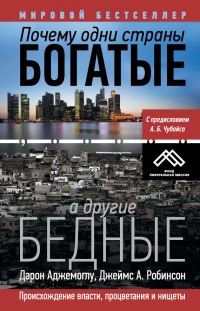
 ЧИТАТЬ КНИГУ ОФЛАЙН в приложении android
Книга Почему одни страны богатые, а другие бедные. Происхождение власти, процветания и нищеты - Дарон Аджемоглу читать онлайн бесплатно без регистрации
Dobb, Maurice (1963). Studies in the Development of Capitalism. Rev. ed. New York: International Publishers.
Dosal, Paul J. (1995). Power in Transition: The Rise of Guatemala’s Industrial Oligarchy, 1871–1994. Westport, Conn.: Praeger.
Douglas, Mary (1962). “Lele Economy Compared to the Bushong.” In Paul Bohannan and George Dalton, eds. Markets in Africa. Evanston, Ill.: Northwestern University Press.
— (1963). The Lele of the Kasai. London: Oxford University Press.
Doyle, William (2001). An American Insurrection: The Battle of Oxford Mississippi. New York: Doubleday.
— (2002). The Oxford History of the French Revolution. 2nd ed. New York: Oxford University Press.
Dreyer, Edward L. (2007). Zheng He: China and the Oceans in the Early Ming Dynasty, 1405–1433. New York: Pearson Longman.
Du Bois, W. E. B. (1903). The Souls of Black Folk. New York: A. C. McClurg & Company.
Dunn, Richard S. (1969). “The Barbados Census of 1680: Profile of the Richest Colony in English America.” William and Mary Quarterly 26: 3–30.
DuPlessis, Robert S. (1997). Transitions to Capitalism in Early Modern Europe. New York: Cambridge University Press.
Easterly, William (2006). The White Man’s Burden: Why the West’s Efforts to Aid the Rest Have Done So Much Ill and So Little Good. New York: Oxford University Press.
Elton, Geoffrey R. (1953). The Tudor Revolution in Government. New York: Cambridge University Press.
Engerman, Stanley L. (2007). Slavery, Emancipation & Freedom: Comparative Perspectives. Baton Rouge: University of Lousiana Press.
Engerman, Stanley L., and Kenneth L. Sokoloff (1997). “Factor Endowments, Institutions, and Differential Paths of Growth Among New World Economies.” In Stephen H. Haber, ed. How Latin America Fell Behind. Stanford, Calif.: Stanford University Press.
— (2005). “The Evolution of Suffrage Institutions in the New World.” Journal of Economic History 65: 891–921.
Evans, Eric J. (1996). The Forging of the Modern State: Early Industrial Britain, 1783–1870. 2nd ed. New York: Longman.
Evans, Peter B. (1995). Embedded Autonomy: States and Industrial Transformation. Princeton, N. J.: Princeton University Press.
Ewald,Janet (1988). “Speaking, Writing and Authority: Explorations in and from the Kingdom of Taqali.” Comparative Studies in History and Society 30: 199–224.
Fagan, Brian (2003). The Long Summer: How Climate Changed Civilization. New York: Basic Books.
Faulkner, Neil (2000). The Decline and Fall of Roman Britain. Stroud, U. K.: Tempus Publishers.
Feinstein, Charles H. (2005). An Economic History of South Africa: Conquest, Discrimination and Development. New York: Cambridge University Press.
Ferguson, Niall (1998). The House of Rothschild: Vol. 1: Money’s Prophets, 17981848. New York: Viking.
Fergusson, Leopoldo (2010). “The Political Economy of Rural Property Rights and the Persistance of the Dual Economy.” Unpublished. http://economia.uniandes.edu.co.
Finley, Moses (1965). “Technical Innovation and Economic Progress in the Ancient World.” Economic History Review 18: 29–4.
— (1999). The Ancient Economy. Berkeley: University of California Press.
Fischer, David H. (1989). Albion’s Seed: Four British Folkways in America. New York: Oxford University Press.
Fogel, Robert W., and Stanley L. Engerman (1974). Time on the Cross: The Economics of American Negro Slavery. Boston: Little, Brown.
Foley, James A. (2003). Korea’s Divided Families: Fifty Years of Separation. New York: Routledge.
Freudenberger, Herman (1967). “The State as an Obstacle to Economic Growth in the Hapsburg Monarchy.” Journal of Economic History 27: 493–509.
Galenson, David W. (1996). “The Settlement and Growth of the Colonies: Population, Labor and Economic Development.” In Stanley L. Engerman and Robert E. Gallman, eds. The Cambridge Economic History of the United States, Volume I: The Colonial Era. New York: Cambridge University Press.
Ganson, Barbara (2003). The Guarani Under Spanish Rule in the Rio de la Plata. Palo Alto, Calif.: Stanford University Press.
Garcia-Jimeno, Camilo, and James A. Robinson (2011). “The Myth of the Frontier.” In Dora L. Costa and Naomi R. Lamoreaux, eds. Understanding Long — Run Economic Growth. Chicago: University of Chicago Press.
Gerschenkron, Alexander (1970). Europe in the Russian Mirror New York: Cambridge University Press.
Ghani, Ashraf, and Clare Lockhart (2008). Fixing Failed States: A Framework for Rebuilding a Fractured World. New York: Oxford University Press.
Gibson, Charles (1963). The Aztecs Under Spanish Rule. New York: Cambridge University Press.
Goldstein, Marcus, and Christopher Udry (2008). “The Profits of Power: Land Rights and Agricultural Investment in Ghana.” Journal of Political Economy 116: 981–1022.
Goldsworthy, Adrian K. (2009). How Rome Fell: Death of a Superpower. New Haven, Conn.: Yale University Press.
Goody, Jack (1971). Technology, Tradition and the State in Africa. New York: Cambridge University Press.
Gregory, Paul R., and Mark Harrison (2005). “Allocation Under Dictatorship: Research in Stalin’s Archives.” Journal of Economic Literature 43: 721–61.
Grieb, Kenneth J. (1979). Guatemalan Caudillo: The Regime of Jorge Ubico, 1931–1944. Athens: Ohio University Press.
Gross, Nachum T. (1973). “The Habsburg Monarchy, 1750–1914.” In Carlo M. Cipolla, ed. The Fontana Economic History of Europe. Glasgow, U. K.: William Collins Sons and Co.
Guiso, Luigi, Paola Sapienza, and Luigi Zingales (2006). “Does Culture Affect Economic Outcomes?” Journal of Economic Perspectives 20: 23–48.
Haber, Stephen H. (2010). “Politics, Banking, and Economic Development: Evidence from New World Economies.” In Jared Diamond and James A. Robinson, eds. Natural Experiments of History. Cambridge, Mass.: Belknap Press of Harvard University Press.
Haber, Stephen H., Herbert S. Klein, Noel Maurer, and Kevin J. Middlebrook (2008). Mexico Since 1980. New York: Cambridge University Press.
Haber, Stephen H., Noel Maurer, and Armando Razo (2003). The Politics of Property Rights: Political Instability, Credible Commitments, and Economic Growth in Mexico, 1876–1929. New York: Cambridge University Press.




Прочитали книгу? Предлагаем вам поделится своим впечатлением! Ваш отзыв будет полезен читателям, которые еще только собираются познакомиться с произведением.
Уважаемые читатели, слушатели и просто посетители нашей библиотеки! Просим Вас придерживаться определенных правил при комментировании литературных произведений.
Просьба отказаться от дискриминационных высказываний. Мы защищаем право наших читателей свободно выражать свою точку зрения. Вместе с тем мы не терпим агрессии. На сайте запрещено оставлять комментарий, который содержит унизительные высказывания или призывы к насилию по отношению к отдельным лицам или группам людей на основании их расы, этнического происхождения, вероисповедания, недееспособности, пола, возраста, статуса ветерана, касты или сексуальной ориентации. Просьба отказаться от оскорблений, угроз и запугиваний. Просьба отказаться от нецензурной лексики. Просьба вести себя максимально корректно как по отношению к авторам, так и по отношению к другим читателям и их комментариям.
Надеемся на Ваше понимание и благоразумие. С уважением, администратор сайта
Оставить комментарий
 Mkot1312 июль 21:17