


Agile: Оценка и планирование проектов - Майк Кон
Книгу Agile: Оценка и планирование проектов - Майк Кон читаем онлайн бесплатно и без регистрации! Читать онлайн вы можете не только на компьютере, но и на андроид (Android), iPhone и iPad. Наслаждайтесь!
441 0 10:01, 04-08-2019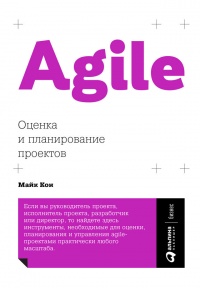
 ЧИТАТЬ КНИГУ ОФЛАЙН в приложении android
Книга Agile: Оценка и планирование проектов - Майк Кон читать онлайн бесплатно без регистрации
Griffin, Abbie, and John R. Hauser. 1993. The Voice of the Customer. Marketing Science 12 (1): 1–27.
Hagafors, R., and B. Brehmer. 1983. Does Having to Justify One’s Decisions Change the Nature of the Decision Process? Organizational Behavior and Human Performance 31: 223–232.
Highsmith, Jim. 2004a. Agile Project Management: Creating Innovative Products. Addison Wesley.
Highsmith, Jim. 2004b. Email to [email protected] on February 16, 2004.
Hobbs, Charles. 1987. Time Power. Harper & Row Publishers.
Hoest, Martin, and Claes Wohlin. 1998. An Experimental Study of Individual Subjective Effort Estimations and Combinations of the Estimates. Proceedings of the 20th International Conference on Software Engineering, pp. 332–339.
Hunt, Andrew, and David Thomas. 1999. The Pragmatic Programmer: From Journeyman to Master. Addison-Wesley.
Jeffries, Ron. 2004. Email to [email protected] on July 1, 2004.
Jeffries, Ron, Ann Anderson, and Chet Hendrickson. 2001. Extreme Programming Installed. Addison-Wesley.
Johnson, Jim. 2002. Keynote speech at Third International Conference on Extreme Programming.
Johnson, Philip M., Carleton A. Moore, Joseph A. Dane, and Robert S. Brewer. 2000. Empirically Guided Software Effort Estimation. IEEE Software 17 (6): 51–56.
Jørgensen, Magne. 2004. A Review of Studies on Expert Estimation of Software Development Effort. Journal of Systems and Software 70 (1–2): 37–60.
Jørgensen, Magne, and Kjetil Moløkken. 2002. Combination of Software Development Effort Prediction Intervals: Why, When and How? Fourteenth IEEE Conference on Software Engineering and Knowledge Engineering.
Keen, Jack M., and Bonnie Digrius. 2003. Making Technology Investments Profitable: ROI Roadmap to Better Business Cases. John Wiley & Sons.
Kennedy, Michael N. 2003. Product Development for the Lean Enterprise: Why Toyota’s System Is Four Times More Productive and How You Can Implement It. The Oaklea Press.
Kernighan, Brian, and P. J. Plauger. 1974. The Elements of Programming Style. McGraw-Hill.
Larson, Carl E., and Frank M. J. LaFasto. 1989. Teamwork: What Must Go Right / What Can Go Wrong. SAGE Publications.
Laufer, Alexander. 1996. Simultaneous Management: Managing Projects in a Dynamic Environment. American Management Association.
Leach, Lawrence P. 2000. Critical Chain Project Management. Artech House.
Lederer, Albert L., and Jayesh Prasad. 1992. Nine Management Guidelines for Better Cost Estimating. Communications of the ACM 35 (2): 51–59.
Lederer, Albert L., and Jayesh Prasad. 1998. A Causal Model for Software Cost Estimating Error. IEEE Transactions on Software Engineering 24(2):137–148.
McClelland, Bill. 2004. Buffer Management. The TOC Times, February.
McConnell, Steve. 1998. Software Project Survival Guide. Microsoft Press.
Macomber, Hal. 2004. Achieving Change in Construction Is a Matter of Mental Models. Reforming Project Management 3 (35): August 29.
Malotaux, Niels. 2004. Evolutionary Project Management Methods. www.malotaux.nl/nrm/pdf/MxEvo.pdf.
Martin, Robert C. 2004. PERT: Precursor to Agility. Software Development, February.
Miranda, Eduardo. 2001. Improving Subjective Estimates Using Paired Comparisons. IEEE Software 18 (1): 87–91.
Mugridge, Rick, and Ward Cunningham. 2005. FIT for Developing Software: Framework for Integrated Tests. Prentice Hall.
Nejmeh, Brian A., and Ian Thomas. 2002. Business-Driven Product Planning Using Feature Vectors and Increments. IEEE Software 34 (6): 34–42.
Newbold, Robert C. 1998. Project Management in the Fast Lane: Applying the Theory of Constraints. St. Lucie Press.
Parkinson, Cyril Northcote. 1958. Parkinson’s Law: The Pursuit of Progress. John Murray.
Poppendieck, Mary and Tom. 2003. Lean Software Development: An Agile Toolkit. Addison-Wesley.
Poppendieck, Mary. 2003. Lean Development and the Predictability Paradox. Agile Software Development and Project Management Executive Report 4 (8). Cutter Consortium.
Putnam, Lawrence H., and Ware Myers. 1997. How Solved Is the Cost Estimation Problem? IEEE Software 14 (6): 105–107.
Rakitin, Steven R. Creating Accurate Estimates and Realistic Schedules. Software Quality Professional 4 (2): 30–36.
Reinertsen, Donald. G. 1997. Managing the Design Factory: A Product Developers’s Toolkit. Free Press.
Rising, Linda. 2002. Agile Meetings. Software Testing and Quality Engineering 4 (3): 42–46.
Saaty, Thomas. 1996. Multicriteria Decision Making: The Analytic Hierarchy Process. RWS Publications.
Sanders, G. S. 1984. Self Presentation and Drive in Social Facilitation. Journal of Experimental Social Psychology 20 (4): 312–322.
Sauerwein, Elmar, Franz Bailom, Kurt Matzler, and Hans H. Hinterhuber. 1996. The Kano Model: How to Delight Your Customers. International Working Seminar on Production Economics 313–327.
Schwaber, Ken, and Mike Beedle. 2002. Agile Software Development with Scrum. Prentice Hall.
Smith, Preston G., and Donald G. Reinertsen. 1997. Developing Products in Half the Time: New Rules, New Tools, 2nd ed. Wiley.
Standish Group International, Inc., The. 2001. Extreme Chaos. www.standishgroup.com/sample_research/ PDFpages/extreme_chaos.pdf.
Takeuchi, Hirotaka, and Ikujiro Nonaka. 1986. The New New Product Development Game. Harvard Business Review, January.
Tockey, Steve. 2004. Return on Software: Maximizing the Return on Your Software Investment. Addison-Wesley.
Van Schooenderwoert, Nancy J. 2004. Interview with Ward Cunningham and Scott Densmore. Agile Times 6: 61–69.
Vicinanza, S., T. Mukhopadhyay, and M. J. Prietula. 1991. Software Effort Estimation: An Exploratory Study of Expert Performance. Information SystemsResearch 2 (4): 243–262.
Weinberg, Gerald M., and E. L. Schulman. 1974. Goals and Performance in Computer Programming. Human Factors 16 (1): 70–77.
Wiegers, Karl. 1999. First Things First: Prioritizing Requirements. Software Development, September.




Прочитали книгу? Предлагаем вам поделится своим впечатлением! Ваш отзыв будет полезен читателям, которые еще только собираются познакомиться с произведением.
Уважаемые читатели, слушатели и просто посетители нашей библиотеки! Просим Вас придерживаться определенных правил при комментировании литературных произведений.
Просьба отказаться от дискриминационных высказываний. Мы защищаем право наших читателей свободно выражать свою точку зрения. Вместе с тем мы не терпим агрессии. На сайте запрещено оставлять комментарий, который содержит унизительные высказывания или призывы к насилию по отношению к отдельным лицам или группам людей на основании их расы, этнического происхождения, вероисповедания, недееспособности, пола, возраста, статуса ветерана, касты или сексуальной ориентации. Просьба отказаться от оскорблений, угроз и запугиваний. Просьба отказаться от нецензурной лексики. Просьба вести себя максимально корректно как по отношению к авторам, так и по отношению к другим читателям и их комментариям.
Надеемся на Ваше понимание и благоразумие. С уважением, администратор сайта
Оставить комментарий

 Mkot1312 июль 21:17


